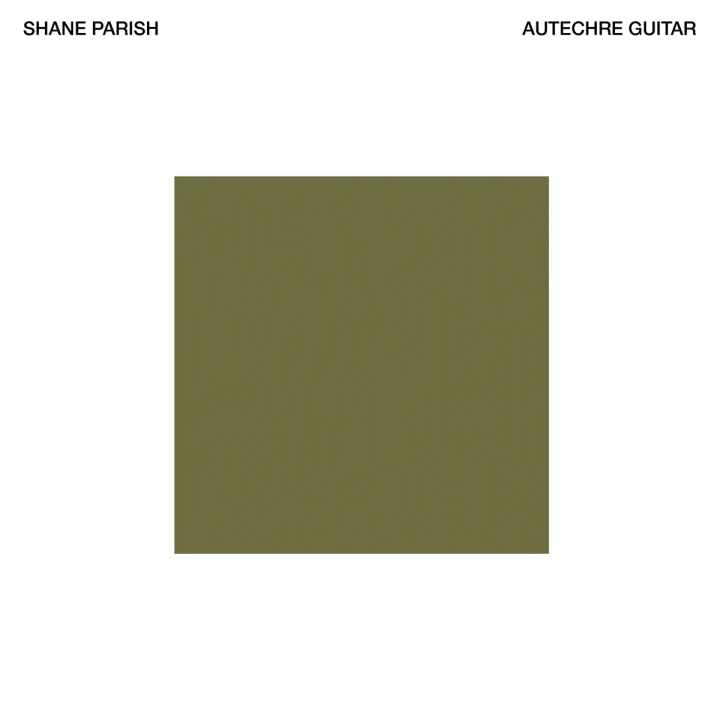
Shane Parish - Autechre Guitar [2xLP]
This record shouldn’t, strictly speaking, be possible at all.
It’s not just that Autechre’s music is electronic and Shane Parish’s is acoustic. It’s not just that Autechre come from electro and techno, while Shane’s solo guitar music is rooted in jazz, folk, and the blues. Those borders, between mediums and genres, are as porous as you want them to be. But Autechre are synonymous with difficulty, opacity, inscrutability—known for unparseable rhythms, cryptic riffs, and shapeshifting timbres. Even on their early records, before they’d begun building out the mind-bending software systems that have defined the past quarter-century of their music, the duo of Sean Booth and Rob Brown were working at the very limits of their machines: eking melodies out of drum sounds, programming intricate polyrhythms of superhuman complexity, and writing sequences that defy attempts to decipher them. I’ve been listening to “Yulquen” for 31 years, and I still couldn’t tell you just what is happening between the melody and the beat; try as I might, I simply can’t count out the steps.
Now take Shane: one guy, one guitar, two hands. Six strings. Ten fingers. (Throw in a tapping foot for when the timekeeping gets tricky.) That’s the sum total of what he’s working with. These are not the kinds of tools you’d think would be equipped for Autechre’s music. But if anyone could take on a project like this, it’s Shane. Informed by his years spent playing standards as a working musician in supper clubs and resorts around Asheville, North Carolina, he’s been arranging music for solo fingerstyle guitar for decades—much of it material originally written for and recorded on other instruments. On his astonishing 2024 album Repertoire, he tackled songs by Ornette Coleman, Charles Mingus, Eric Dolphy, Alice Coltrane, and even Kraftwerk and Aphex Twin, zeroing in on the essence of each and rendering it into his own sure-footed yet exploratory style.
The origins of Autechre Guitar run deep. Last year, Shane posted a low-key nylon-string performance of “Slip,” recorded in his living room, on YouTube. But his first attempt at the song was actually way back in 2004, when he notated his first rudimentary transcription of its serpentine melody—a 29-beat phrase that seems to slip and slide over a 4/4 pulse, to subtly unsettling effect. He had returned to the song over the years, with a vague idea of eventually doing something more with it; finally, after Repertoire’s Kraftwerk and Aphex Twin covers—and with the urging of his wife, a die- hard Autechre fan—he decided to try his hand at an entire album of Autechre covers, and sat down to begin notating songs, one by one. Puzzling out the sequences. Arranging the counterpoints. Translating shades of pewter and graphite into something resembling a 12-tone scale. And, most importantly, finding ways to distill Autechre’s seemingly limitless details in ways that could be played by just 10 fingers without losing the soul of the song. It was, in essence, a kind of sleight of hand.
Product Information
Product Information
Shipping & Returns
Shipping & Returns
Description
This record shouldn’t, strictly speaking, be possible at all.
It’s not just that Autechre’s music is electronic and Shane Parish’s is acoustic. It’s not just that Autechre come from electro and techno, while Shane’s solo guitar music is rooted in jazz, folk, and the blues. Those borders, between mediums and genres, are as porous as you want them to be. But Autechre are synonymous with difficulty, opacity, inscrutability—known for unparseable rhythms, cryptic riffs, and shapeshifting timbres. Even on their early records, before they’d begun building out the mind-bending software systems that have defined the past quarter-century of their music, the duo of Sean Booth and Rob Brown were working at the very limits of their machines: eking melodies out of drum sounds, programming intricate polyrhythms of superhuman complexity, and writing sequences that defy attempts to decipher them. I’ve been listening to “Yulquen” for 31 years, and I still couldn’t tell you just what is happening between the melody and the beat; try as I might, I simply can’t count out the steps.
Now take Shane: one guy, one guitar, two hands. Six strings. Ten fingers. (Throw in a tapping foot for when the timekeeping gets tricky.) That’s the sum total of what he’s working with. These are not the kinds of tools you’d think would be equipped for Autechre’s music. But if anyone could take on a project like this, it’s Shane. Informed by his years spent playing standards as a working musician in supper clubs and resorts around Asheville, North Carolina, he’s been arranging music for solo fingerstyle guitar for decades—much of it material originally written for and recorded on other instruments. On his astonishing 2024 album Repertoire, he tackled songs by Ornette Coleman, Charles Mingus, Eric Dolphy, Alice Coltrane, and even Kraftwerk and Aphex Twin, zeroing in on the essence of each and rendering it into his own sure-footed yet exploratory style.
The origins of Autechre Guitar run deep. Last year, Shane posted a low-key nylon-string performance of “Slip,” recorded in his living room, on YouTube. But his first attempt at the song was actually way back in 2004, when he notated his first rudimentary transcription of its serpentine melody—a 29-beat phrase that seems to slip and slide over a 4/4 pulse, to subtly unsettling effect. He had returned to the song over the years, with a vague idea of eventually doing something more with it; finally, after Repertoire’s Kraftwerk and Aphex Twin covers—and with the urging of his wife, a die- hard Autechre fan—he decided to try his hand at an entire album of Autechre covers, and sat down to begin notating songs, one by one. Puzzling out the sequences. Arranging the counterpoints. Translating shades of pewter and graphite into something resembling a 12-tone scale. And, most importantly, finding ways to distill Autechre’s seemingly limitless details in ways that could be played by just 10 fingers without losing the soul of the song. It was, in essence, a kind of sleight of hand.